Every fall, a new crop of eighth graders across the country – and their parents – are introduced to a slew of new acronyms denoting the standardized tests they will have to take to apply to private high school. Most of us are familiar with the SAT and ACT, the much-discussed and polarizing standardized tests that colleges have traditionally used to make their admissions decisions. The SSAT, ISEE, HSPT, and PSAT 8/9 on the other hand – not so much, due both to the diffuse nature of high school admissions tests and to the fact that most American middle-schoolers don’t apply to private or magnet high schools. Those that do, though, and those who are planning to do so this fall have no doubt heard of these tests, and our aim today is to elucidate them for students and parents embarking on their high school admissions journeys.
The tests at the center of our discussion today – the SSAT, ISEE, HSPT, and PSAT 8/9 – are merely part of a kaleidoscope of standardized tests used by private, parochial, and magnet high schools in the US in determining which students to admit. There are many others, as well, but these four are the most widely used and most widely accepted tests by schools in our geographic area (the northeastern US). Some high schools only accept one of these tests; others accept all four and leave up to the student which to submit. Though they all test relatively the same skills, they do so differently: different question types, different patterns, different timing parameters. Consequently, they all require somewhat different approaches to preparation. Let’s take a look at each of these tests individually, and then we’ll highlight their important similarities and differences.
The PSAT 8/9
If you’re familiar with the current version of the SAT, then you’re familiar with the PSAT 8/9. This test is essentially a “junior” version of the SAT. In actuality, the only differences between the PSAT 8/9 and the SAT are the scoring scales – PSAT 8/9 has a maximum score of 1440, while the SAT has a maximum score of 1600 – and the level of difficulty of the hardest questions. Everything else is the same: they both test the same skills in the same way, with the same format. Like the SAT, the PSAT 8/9 uses a digital, adaptive format. It consists of two Reading and Writing modules followed by two Math modules, with the difficulty of the second module in each section determined in part by how the student performs on the first.
The entire test contains 98 questions and takes 2 hours and 14 minutes: 54 Reading and Writing questions in 64 minutes and 44 Math questions in 70 minutes. Relatively short both in terms of duration and question numbers when compared to the other tests we’ll discuss today. Consequently, stamina isn’t quite as big of a factor as it is on the other tests. And speed certainly isn’t – students have more than a minute per question throughout the test, so they can and should take their time to read everything carefully, think things through, and diligently do the necessary figuring on every question.
The Reading and Writing modules consist of small passages – anywhere from one to four or so sentences – each with exactly one question. Each Reading and Writing module is split in half, with the first half testing Reading and the second half testing Writing skills. Questions do not progress in order of difficulty, strictly speaking, but students report finding the later Reading passages (questions ~10 – 15 or so) to be more challenging.
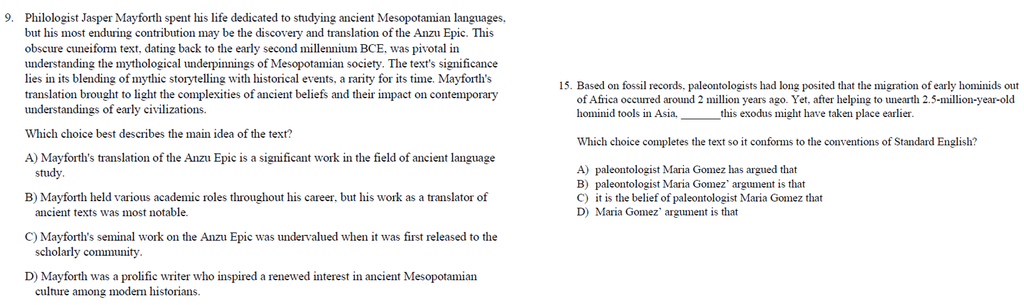
| Examples of a PSAT 8/9 Reading question (left) and Writing question (right) |
Though the Reading passages are short, they can be very difficult to understand. Students will really have to put on their thinking caps and turn their focus/attentiveness levels to the proverbial 11 to fully comprehend some of these passages. And fully comprehend them you must if you hope to find the correct answer in a sea of answer choices that all look and feel like they could be right. The Reading questions on the PSAT require a lot of hard, careful thought to master. For most students, the hardest Reading questions will be the hardest questions on the entire test.
The Writing Skills questions can be challenging as well, but students will likely find these a bit easier than the toughest Reading questions. Still, they will need to learn the ways in which the PSAT actively tries to “trick” students on these questions. Luckily, there are only a handful of grammatical rules that students need to know for this test, and they are usually all tested in the same basic way on each administration of the PSAT.
The Math modules consist of math questions, of course, mostly – but not all – multiple choice. Each module will also have between 5 and 7 Free Response questions. Those are open-ended questions for which students must input a number on their own as their answer.
As is customary with many standardized tests these days, the math questions progress in a rough order of difficulty. That is, the earlier questions in each module are easier and the later questions in each module are harder.
One major difference between the PSAT 8/9 and the other three tests we’ll be discussing here is that students are allowed to use a calculator on the math section. In fact, the test embeds the Desmos Graphing Calculator into the testing app, so students don’t have to bring their own calculator if they prefer not to. And if you’re not already familiar with Desmos, this calculator is incredibly advanced and helpful to students. Every student’s PSAT 8/9 prep has to include Desmos as a major focus. It’s truly a game-changer.
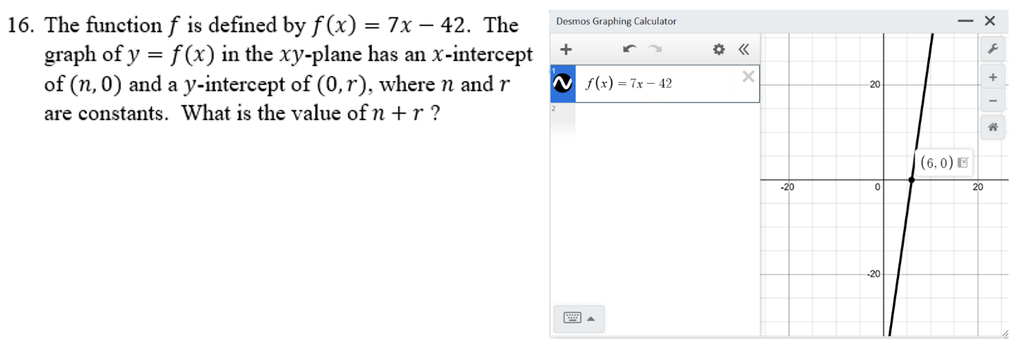
| Examples of a PSAT 8/9 free-response Math question (left) and Desmos Graphing Calculator (right) |
The math questions on this test – especially the harder ones – are more like math “puzzles”: multi-step questions that require a good amount of deep thinking and creativity to solve. In that way, PSAT math questions can feel very different from the math students have done in school, and it can take time for students prepping for the PSAT to acclimate to the style of these harder math questions.
Finally, because the PSAT 8/9 is essentially identical to the SAT, students prepping for the PSAT are, in a real way, getting a bit of a leg up for their SAT prep in a few years.
The HSPT
The HSPT – High School Placement Test – is primarily used by Catholic high schools and was designed specifically to assess eighth graders entering ninth grade. Unlike the PSAT 8/9, it has no connection to the SAT or ACT. The HSPT tests mostly the same skills as the PSAT 8/9, but in a very different way. Unlike the tricky “puzzles” and dense, wonky passages of the PSAT 8/9, the HSPT offers quick, simple math questions and straightforward passages. What makes the HSPT difficult is the sheer number of questions and miniscule amount of time students have to answer them: 298 questions over the course of 2 hours and 21 minutes. Compare that to the PSAT’s 98 questions in 2 hours and 14 minutes and you can see how much faster students have to go on the HSPT to get it all done.
The standard HSPT contains five multiple-choice sections:
- Verbal Skills
- Quantitative Skills
- Reading
- Mathematics
- Language
The Verbal Skills section consists of vocabulary-based questions and logic questions. Many of them are incredibly simple, essentially asking for the meaning of a given word, and some of them are a bit more complex, requiring students to decipher the relationship between two words (analogies) or asking them to work out a logic puzzle that’s almost closer to a math question than it is to a traditional “verbal” question. Though vocabulary study is an essential part of mastery over the HSPT, this section is more than just a vocabulary test, and students must also actively prepare for those other elements of this section as well.
The Quantitative Skills section consists of a mixture of simple math and pattern-recognition questions. Everything from translating a sentence into an algebraic equation (and then solving it) to determining the missing term in a given alpha-numeric sequence. The types of questions tested on the Quantitative Skills section are incredibly predictable and repetitive, making mastery of the section easier than it would otherwise seem. You don’t need to be nearly as creative and thoughtful on this section as you do on the Math section of the PSAT 8/9; once you’ve learned the common patterns on this section, the only challenge is finishing in time while avoiding careless mistakes.
Very important to note about the math sections of this test: students are NOT allowed a calculator on the HSPT.
The Reading section is split into two parts: reading comp and vocabulary. The reading comp part is four long-ish passages each with ten questions. Very basic stuff: read the passage and answer the questions about it. The questions aren’t particularly tricky and neither are the answer choices. Again, speed is the name of the game here. The vocabulary part comes next, with 22 questions that essentially just test whether a student knows the meanings of certain vocabulary words. There is some context given in each of these questions, which does help, but to be successful here, students do need to have a fairly extensive vocabulary. The words on this section, by and large, aren’t quite as advanced as they are on the ISEE or SSAT, but they aren’t basic words that everyone knows. Some vocab study is necessary to master this section.
The Math section is actually a bit different from the Quantitative Skills section in that it essentially just tests students’ manual and mental math skills. No pattern recognition or sequencing questions like in the Quant Skills section earlier in the test. These questions test your ability to do basic addition, subtraction, multiplication, and division; they test your facility with fractions, decimals, and percents; and they test basic geometry concepts and your familiarity with graphs and tables. Same as with the Quantitative Skills section, though, you have to move quickly and accurately to score well here. Which isn’t terribly easy when you don’t have a calculator to help you. Consequently, students are rewarded for being able to estimate quickly and “ballpark” their answers. Much of a student’s prep for this section of the HSPT should revolve around developing those skills.
Finally, the Language section tests students’ facility with the rules of English grammar, spelling, punctuation, and rhetorical skills. These multiple choice questions are relatively straightforward, but mastering this section will require students to familiarize (or re-familiarize) themselves with things like how and when to use commas, apostrophes, and semicolons, irregular possessives, and the rules of capitalization. Spelling is also tested on a subset of these questions, and at the end of the section students will find questions testing transition words and sentence placement. Not a terribly difficult section, but when you’re moving through it as fast as possible, it’s easy to miss a word usage error or misinterpret a sentence.
By and large, the material tested on the HSPT is easier than that tested on any of the other three tests we’re discussing today. But it’s also a much faster test than any of them. Success on this test isn’t just about whether a student can solve a problem. It’s about whether they can recognize the question type, identify an efficient approach, and solve it quickly enough to move on.
The ISEE
The ISEE – Independent School Entrance Examination – is widely used by independent and private schools. Many catholic and parochial schools allow students to submit ISEE results for admissions purposes as well. It’s probably the most widely-accepted high school admissions test in the country. The test comes in several different levels depending on a student’s grade, but eighth graders applying to high school will take the Upper Level ISEE, which is given to students applying to grades 9–12.
The Upper Level ISEE consists of five sections:
- Verbal Reasoning
- Quantitative Reasoning
- Reading Comprehension
- Mathematics Achievement
- Essay
At first glance, the ISEE looks somewhat similar to the HSPT. Both tests have separate verbal, reading, quantitative, and math sections. But the ISEE is a significantly different test – and, in general, the questions themselves are more challenging.
The Verbal Reasoning section is where one of the biggest differences becomes apparent. Unlike the PSAT 8/9, on which vocabulary is only sparingly tested, vocabulary is a rather large part of the ISEE. The section consists of two types of questions: synonyms and sentence completions.
The synonym questions are exactly what they sound like. Students are given a word and asked to choose the answer choice that is closest in meaning to it. There’s no passage or sentence to provide context. Either you know the word, you can figure it out based on your knowledge of roots and prefixes, or you’re making an educated guess.
And the vocabulary can get difficult.
These aren’t just words that a strong eighth-grade reader is necessarily going to encounter in everyday life. Students preparing for the ISEE should expect vocabulary study to be an important part of their prep. Learning common Greek and Latin roots, prefixes, and suffixes is also particularly useful here because even when students encounter an unfamiliar word – and they will – they may be able to decipher enough of it to make a good guess.
Sentence completions give students a bit more to work with. Students are presented with a sentence containing one or two blanks and must determine which word or words best complete it. These questions still require a strong vocabulary, but students can use the context and logic of the sentence to help them determine what kind of word belongs in the blank.
The Quantitative Reasoning section is the first of the ISEE’s two math sections, and the name is important. This isn’t simply a section asking, “Do you know how to do math?” It’s more interested in whether students can reason mathematically.
Students will encounter word problems, algebra, geometry, data analysis, probability, and other familiar mathematical concepts, but the questions tend to require more thought than straightforward computation. Students have to figure out what the question is really asking, determine what information matters, and decide how to use it. Furthermore, the second half of this section consists of “Quantitative Comparison” questions, which ask students to determine which of two quantities is larger (or if they’re the same or if there’s no way to determine whether one is larger than the other). Seems simple enough, but when you add in variables, constants, and other unknowns – a hallmark of these questions – they can get pretty tricky.
In that sense, there are some similarities to the PSAT 8/9. Both tests can turn relatively basic mathematical concepts into questions that require a good amount of problem-solving. But unlike the PSAT 8/9, students cannot use a calculator on the ISEE. That makes strong arithmetic skills – and the ability to work accurately by hand – much more important.
The Reading Comprehension section is pretty typical of reading comprehension sections on standardized tests. Like the first half of the HSPT’s reading comp section, it consists of long-ish passages followed by several questions about each passage. Students will be asked about things like the main idea of a passage, supporting details, inferences, vocabulary in context, the author’s purpose, and how a passage is organized.
The passages themselves cover a variety of topics and can be fairly sophisticated. Much like they do on the HSPT and SSAT, ISEE students have to read and keep track of much longer pieces of writing. That makes stamina and the ability to read actively particularly important. The questions are generally more straightforward than the trickier PSAT Reading questions, but that doesn’t make the section easy. Students have to be able to separate what a passage actually says from what they think, assume, or remember about the subject. As with pretty much every standardized reading test ever created, the correct answer has to be supported by the text.
The Mathematics Achievement section is the second math section. Whereas Quantitative Reasoning focuses more on problem-solving, Mathematics Achievement is more directly concerned with whether students know the math they’ve been taught.
Students will see questions involving numbers and operations, algebra, geometry, measurement, data analysis, probability, and other grade-appropriate concepts. The questions tend to be more straightforward than those in Quantitative Reasoning: know the concept, perform the necessary math, and choose the correct answer.
But again: no calculator.
Students who have grown accustomed to reaching for a calculator whenever they encounter an ugly fraction or decimal may need some time to reacquaint themselves with doing this work manually. Being able to manipulate fractions, calculate percentages, simplify expressions, and perform basic arithmetic quickly and accurately is important on both ISEE math sections.
Finally, students complete a 30-minute essay. The essay is not included in the student’s numerical ISEE score, but don’t mistake “unscored” for “unimportant.” The essay is sent to the schools receiving the student’s score report, meaning admissions officers can read it as an actual sample of the student’s writing.
Students are given a relatively broad prompt and asked to write an essay responding to it. Nobody is expecting an eighth grader to produce the next great American novel in 30 minutes. Schools are looking at whether students can develop an idea, organize their thoughts, support what they’re saying, and communicate clearly.
Overall, the ISEE is a test that rewards strong vocabulary, careful reading, mathematical reasoning, and a solid command of foundational math skills. It isn’t nearly as speed-driven as the HSPT, but students still have to work efficiently. And because calculators aren’t allowed and vocabulary plays such a prominent role, there are some old-school standardized testing skills that students absolutely need to dust off.
The SSAT
The SSAT – Secondary School Admission Test – is also used primarily by independent and private schools, and it is by far the easiest of these four tests to confuse with the ISEE. That’s because the two tests have a lot in common.
Like the ISEE, the SSAT is offered at different levels depending on the student’s grade. Eighth graders applying to high school take the Upper Level SSAT, which is intended for students currently in grades 8–11.
The Upper Level SSAT consists of:
- 1 Essay (called the Writing Sample)
- 2 Quantitative sections
- 1 Reading section
- 1 Verbal section
Not necessarily in that order.
For the Essay – or “Writing Sample”, as it’s referred to by the SSAT, students are given 25 minutes and a choice between two prompts: a personal question or a general question. They choose one and write an essay responding to it.
Just like on the ISEE, the SSAT Writing Sample does not factor into the student’s overall score. But schools receive a copy of it, so students should still take it seriously. It is an opportunity for an admissions office to see how a student thinks and writes without the benefit of parents, teachers, spellcheck, AI, or three weeks of revisions.
There are two Quantitative sections on the SSAT. Unlike the ISEE, the SSAT doesn’t divide its math questions into separate “reasoning” and “achievement” categories. Instead, the test has two Quantitative sections containing a mixture of arithmetic, algebra, geometry, data analysis, and other mathematical concepts. The math itself isn’t outrageously advanced. What can make the SSAT difficult is the way relatively familiar concepts are packaged. Students need to read carefully, translate word problems into math, recognize which concept is being tested, and work efficiently. These questions are generally closer to the math puzzles of the PSAT and ISEE than they are to the basic and straightforward math of the HSPT.
And just like the ISEE and HSPT, calculators are not allowed.
That is an important adjustment for many students. Between schoolwork, phones, laptops, and Desmos, today’s students aren’t exactly spending their free time practicing long division. Students preparing for the SSAT need to make sure their manual arithmetic skills are sharp enough that the lack of a calculator doesn’t slow them down or lead to unnecessary mistakes.
Next comes Reading, which consists of passages followed by questions about them. Almost identical to the reading comprehension portions of the HSPT and ISEE: long-ish passages accompanied by a bank of questions testing how well you’ve understood them. The basic skills being tested here are what you’d expect: main idea, supporting details, inference, vocabulary in context, author’s purpose and tone, and other reading-comprehension skills. The passages can come from fiction, humanities, science, social studies, and other subject areas, so students need to be comfortable switching gears. A student might go from analyzing a literary passage to reading about a scientific concept he or she has never encountered before.
As with the ISEE, the key isn’t prior knowledge. Everything students need to answer the questions is in the passage. The challenge is reading carefully enough – and efficiently enough – to find it.
Then we arrive at the Verbal section. If vocabulary isn’t your thing, well…you’re probably not going to love this part of the SSAT. It’s just as vocab-intensive as the ISEE, arguably even more so. The Verbal section consists of two types of questions: synonyms and analogies. The synonym questions on the SSAT and ISEE are identical: here’s a word; which answer choice means approximately the same thing?
The analogy questions add another layer. Students are given a pair of words that have some relationship to one another and then have to identify another pair with the same relationship. For example, if the relationship were something like puppy is to dog, students would need to recognize that the first word is the young form of the second and then find another pair that works the same way. Of course, actual Upper Level SSAT questions can be considerably more difficult than puppy : dog. And if a student doesn’t know what one or more of the words mean, figuring out the relationship becomes substantially harder.
Consequently, vocabulary preparation is absolutely essential for the SSAT. Of all four tests we’re discussing here, the SSAT arguably places the greatest premium on having a large vocabulary. Students should spend time learning words, but they should also study roots, prefixes, and suffixes and learn how to make educated guesses when they inevitably encounter words they’ve never seen before.
There is also one particularly important difference between the SSAT and the other tests we’ve discussed: the SSAT penalizes students for wrong answers.
On the Upper Level SSAT, students receive one point for a correct answer, zero points for a question left blank, and lose one-quarter of a point for an incorrect answer. That changes strategy.
On most modern standardized tests, our advice is simple: never leave anything blank. There is no penalty for guessing, so even if you have absolutely no idea what the answer is, you might as well pick something. Not so on the SSAT. Students need to learn when it makes sense to guess and when it makes more sense to leave a question unanswered. If you can confidently eliminate one or more answer choices, guessing becomes much more attractive. If you have absolutely no idea and can’t eliminate anything, leaving the question blank may be the better move.
That strategic wrinkle – combined with the difficult vocabulary – is one of the things that makes the SSAT feel so different from the tests students are accustomed to taking in school.
Overall, the SSAT and ISEE are much more closely related to one another than either is to the PSAT 8/9 or HSPT. A student preparing for both can carry over a lot of skills from one test to the other: vocabulary, reading comprehension, manual math, algebra, geometry, and general test-taking skills.
But they aren’t identical. The ISEE separates mathematical reasoning from mathematical achievement, while the SSAT mixes its math content across two Quantitative sections. The SSAT leans particularly heavily into vocabulary and analogies. And the SSAT’s guessing penalty introduces a strategic element that simply doesn’t exist on the ISEE.
Since most private high schools that accept the SSAT also accept the ISEE – a relationship that isn’t true of the PSAT 8/9 and HSPT – these similarities and differences should be taken into account when a student is choosing which of these tests to prepare for. So if a student needs to take both, there is no reason to prepare for them as two completely separate tests. Build the common foundation first, then spend some time learning the quirks of each.
So How Different Are These Tests, Really?
The oversimplified answer is “somewhat.” All four tests assess reading and mathematics in some form. Beyond that, however, the emphasis starts to diverge.
The PSAT 8/9 places students squarely in the SAT ecosystem, with Reading and Writing and Math presented in the same basic digital, adaptive structure they’ll encounter later.
The HSPT spreads students across a particularly wide variety of verbal, quantitative, reading, math, and language skills — and asks them to work quickly.
The ISEE and SSAT are the closest cousins of the group. Both combine reading and mathematics with dedicated verbal and quantitative reasoning and both include an unscored writing sample. But even these two tests have important differences in question types, scoring, pacing, and strategy.
So here’s the simplest way to think about them:
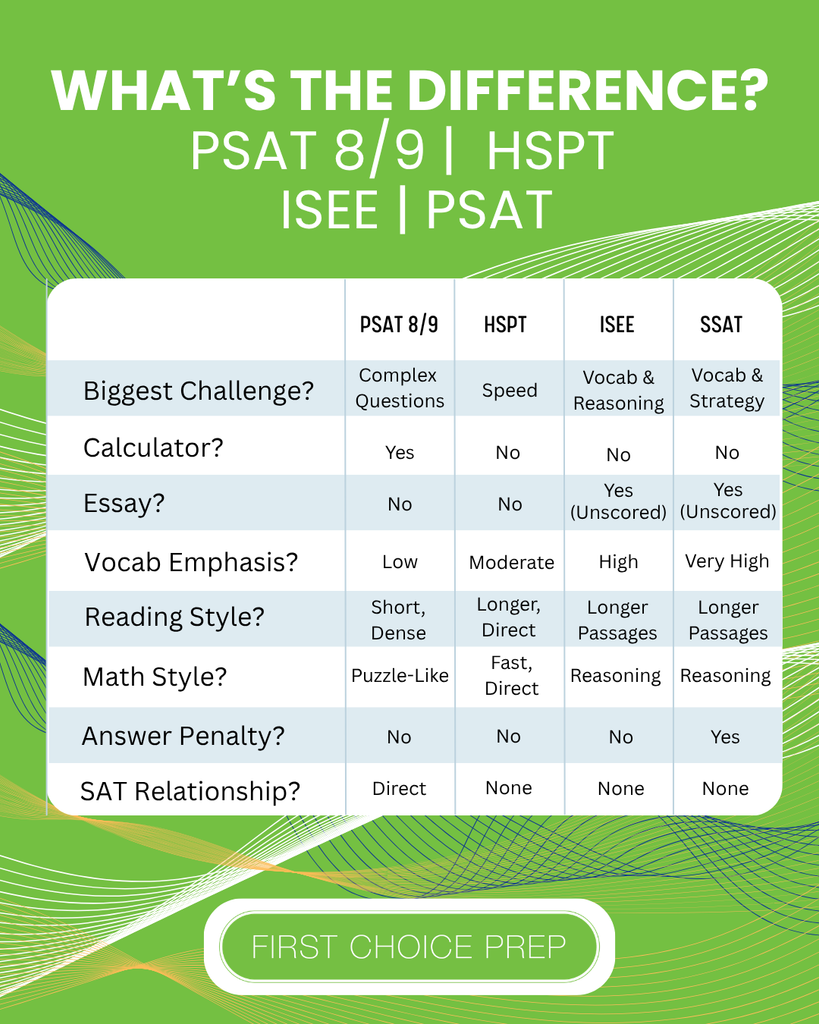
PSAT 8/9: Think early SAT. It emphasizes Reading/Writing and Math and closely mirrors the structure and question styles students will eventually encounter on the SAT. Calculators allowed on math.
HSPT: Think speed + breadth. It tests a wide range of academic and reasoning skills, including several question types students may rarely encounter in school.
ISEE: Think academic achievement + reasoning. It combines traditional reading and math with dedicated verbal and quantitative reasoning sections, plus an unscored writing sample.
SSAT: Think vocabulary + reasoning. It has considerable overlap with the ISEE, but puts particularly strong emphasis on vocabulary and analogies and introduces a guessing penalty that changes test-taking strategy.
What If My Child Has to Take More Than One?
This is where families understandably start to panic.
If School A requires the PSAT 8/9, School B requires the HSPT, and Schools C and D accept the ISEE or SSAT, does your eighth grader suddenly need to prepare independently for four completely different standardized tests?
Thankfully, no.
There is enough overlap among the exams that much of the foundational preparation can serve double — or even triple — duty.
The key is to build the underlying skills first: reading comprehension, grammar, vocabulary, arithmetic, algebra, geometry, and general problem-solving. Once those foundations are strong, preparation can branch into the test-specific material.
An HSPT student may need additional work on analogies, classifications, number series, and pacing. An ISEE student may need more vocabulary development, quantitative reasoning, and essay practice. An SSAT student will want to devote particular attention to vocabulary, analogies, and the test’s unique guessing strategy. A PSAT 8/9 student should spend more time becoming comfortable with College Board’s particular question styles, adaptive structure, and digital testing environment.
There is one important exception here: the ISEE and SSAT. Because these tests overlap so substantially, most private schools that accept one also accept the other. And because there is generally no advantage to submitting both, students applying exclusively to schools that accept either test usually only need to choose one to prepare for.
You don’t need to start from scratch every time you encounter a different test. Build the underlying skills once, then layer on the question types, strategies, and pacing demands unique to whichever exams your child actually needs to take.
Which Test Should My Child Take?
Unlike the SAT and ACT, this often isn’t really your decision.
High schools determine which admissions tests they accept or require, so your child’s school list will largely dictate which exam — or exams — you’ll need to prepare for.
Some independent schools may accept either the ISEE or SSAT. Catholic schools may require the HSPT. Other selective schools – McNair in Jersey City, for example – may use the PSAT 8/9. And some schools have their own admissions tests or don’t require standardized admissions testing at all.
Before beginning preparation, therefore, the first step should be remarkably low-tech: make a list.
Write down every school your child is considering and determine which admissions test each accepts, which it prefers (if any), and when that test will be administered.
Once you know what you’re dealing with, you can build a preparation plan that takes advantage of the considerable overlap among the tests without overlooking the important differences.
Because while the ISEE, SSAT, HSPT, and PSAT 8/9 may all be used for the same basic purpose — helping high schools evaluate prospective students — the tests themselves are anything but interchangeable.
And the better students understand the particular game they’re playing, the better prepared they’ll be to play it.

Leave a Reply