Choosing between the SAT and ACT is an essential first step in any student’s test prep journey. It’s like choosing which instrument you want to learn or which sport you’re going to play for your school team before you embark on mastering that skill. And because the SAT and ACT are both universally accepted – and equally weighted – by colleges, that choice really just comes down to which of these tests better suits your testing predispositions and preferences. They are different tests, after all, with different structures, pacing, content emphasis, and question style, and those differences can have a real impact on how comfortable and successful a student feels on test day.
What’s important to understand, though, is that once you make that choice, your goal should be to go all in on that one exam. Colleges don’t reward students for submitting strong scores on both the SAT and ACT; they simply evaluate your highest score from either test. Consequently, trying to prepare for both can actually divide your focus and slow your progress. The most effective approach is to identify the better fit early and dedicate your time and energy to mastering that one test.
How are these tests different, you ask? How do you determine which one you should prep for? Let’s take a deeper look at the specs of each one:
The SAT
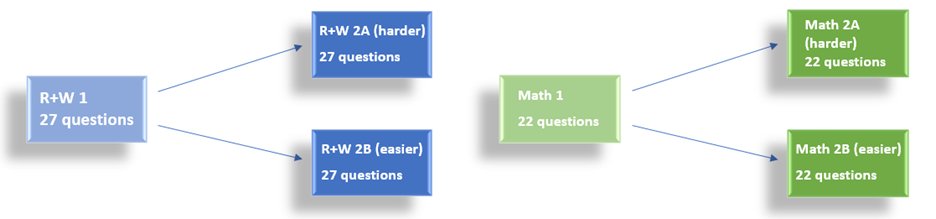
The SAT consists of 4 total sections: two Reading/Writing and two Math, in that order. With standard time, the test is just under 2.5 hours long; with extended time (1.5x standard time) that increases to just over 3.5 hours. The test is only offered digitally, and students have to bring their laptops or tablets with them to the testing center to take the test. The reason it’s only offered digitally is that the SAT is now section-adaptive. That is, your second section (the SAT calls them “modules”) of each half of the test will either be harder or easier than the first section, depending on your performance on the first module. And your score will also be greatly affected by which of those two 2nd modules you receive: “good” scores – those that would be submittable to competitive colleges – are only possible for students who receive the harder 2nd module.
In general, the content on the SAT is more challenging, trickier, and requires deeper thinking and knowledge. The passages, for example, are very short – only 2-3 sentences in many cases – but they can be incredibly difficult to understand. Many are densely packed with information, logical twists and turns, and specialized jargon from disciplines that high school students have zero experience with or context for. On top of that, the answer choices on these questions can be incredibly difficult to decipher, full of confusing language and decoys meant to entice students to pick wrong answer choices. This is by no means true of all Reading and Writing questions on the SAT, but it is true of a large portion of them.
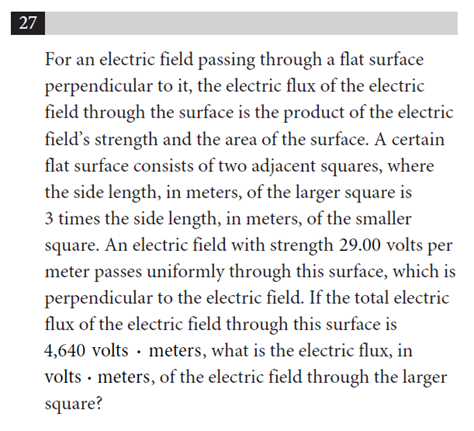
The Math portion of the test is similarly challenging, but it’s challenging not because it tests advanced math like precalculus or calculus. In fact, the concepts tested are fairly straightforward and rudimentary. A vast majority of the “harder” SAT math questions deal with concepts in Algebra 2 or lower. The reason SAT math is challenging is that students are asked to dive deep into these math concepts and solve what are essentially complex math puzzles that would test the mettle of a seasoned high school mathlete. On top of that, the SAT seems to go out of its way to make these questions look scary, so there’s an intimidation factor that students need to get past in order to truly succeed on that section of the test. This can be done with practice, of course, but it can take a while for a student to completely inure themselves to the various intimidation tactics the test likes to employ on the hardest questions.
The question below is an example of an incredibly challenging and intimidating math puzzle that, believe it or not, just tests simple geometry. Again, these questions aren’t common, but they are an element of essentially every SAT.
The ACT
The ACT is similar to the SAT, but, of course, they are not the same test. One very big difference between them is that the ACT is not an adaptive test. It is also offered both on paper and digitally, and both versions of the test are the same.
The ACT also consists of 4 total sections – English, Math, Reading, and Science – and it generally tests the same types of skills as the SAT: grammar and rhetorical skills, math, reading comprehension, graph interpretation and the ability to interpret scientific jargon that students have little to no context for. It tests these skills in a very different way than the SAT does, though.
For one, the questions are generally less involved, require less deep thinking, and are less intimidating than much of the harder material tested on the SAT. It’s also a quicker test – there are more questions that students have less overall time to complete. The ACT has a total of 171 questions (131 if you don’t count the Science – we’ll get to that in a minute) that students are given 165 minutes to complete (125 minutes without the Science section). That’s just under one minute per question, on average. The SAT, on the other hand, consists of 98 questions that students are given a total of 134 minutes for – an average of 1:22 per question. Students do have to think and puzzle their way through ACT questions, but not to the extent that SAT test-takers have to.
On the English and Reading sections, students are presented with longer passages, much like the traditional reading comp passages from the SAT years ago. Students are required to read those longer passages and answer “banks” of questions pertaining to them. The passages themselves are significantly easier to understand than the most challenging passages found on the SAT. And the questions are generally straightforward and devoid of the complexity and intentional deception found in the answer choices of some of the hardest SAT Reading questions. The caveat, of course, is that on the ACT, students have to move much more quickly to be able to read the passages and answer all the questions in the allotted time.
The math section also has more straightforward and less complex questions, but the harder questions test more advanced math from a much broader swath of topics than the SAT does. Whereas the SAT is narrowly-focused on a small set of math concepts – and tests students’ deeper understanding of and ability to be creative with them – the ACT is focused more on testing students’ knowledge of rather obscure math concepts in a more superficial way.
And then there’s the matter of the Science section, for which the SAT has no analog. The Science section of the SAT tests students’ ability to understand scientific experiments and studies in passage form. The format of the Science section is very similar to that of the Reading section: longer passages with accompanying question banks. The passages are shorter on the Science than they are on the Reading, and most of them also contain graphs and tables that illustrate the results of the scientific experiments and studies the passages describe. Consequently, this section can be intimidating to students, but, like everything else on the ACT, it is straightforward and essentially just tests whether students can read the passages and answer the questions in the allotted time.
We should also mention that the Science section is now optional for students. You can find more info on that in our earlier blog post on the changes to the ACT. Suffice to say, though, that this section may not need to be part of your student’s testing plans. Be sure to check the admissions policies of the colleges you’re interested in, though, as some do require ACT testers to submit their Science scores.
There’s also an optional essay section that is essentially vestigial, as most colleges don’t consider students’ ACT essay scores, even if they opt to take that section of the test.
Are you an SAT kid or an ACT kid?
Despite the fact that the differences between these tests are clearly defined, we feel that you never truly know which one you should be prepping for without first taking a diagnostic test to see which one you naturally score better on. That’s why we designed our SAT/ACT Diagnostic Comparison Test – a hybrid test that includes all of the most commonly-tested elements of both the SAT and ACT that you can take in one sitting. Scores and score reports are available instantly, as well, so there’s no pesky waiting for days or weeks to be able to make an informed decision as to which one you should be prepping for. We recommend it to all of our students looking to start test prep.
That said, there are some characteristics of these tests – and of test-takers – that might suggest an inclination towards one over the other. Here are a few things that might make you better-suited to the SAT or ACT:
Likely SAT
- Deep thinker
- Excellent at close reading
- Extensive vocabulary
- Doesn’t like being rushed
- Likes solving puzzles
Likely ACT
- Works quickly and trusts instincts
- Good retention when reading
- Good testing stamina
- All A’s in math in high school
- Receives time and a half accommodations
That all said, we always find it’s best to try them out and trust the numbers. That’s why we always recommend that students new to prep start with our SAT/ACT Diagnostic. It takes all the guesswork out of what is a very important decision in a student’s testing journey.
If you’re not sure where to start, that’s exactly what we’re here for. Feel free to reach out to us anytime if you’d like help figuring out which test is the better fit, or if you want to learn more about our SAT/ACT Diagnostic Comparison Test and how it can take the guesswork out of the decision.

Leave a Reply